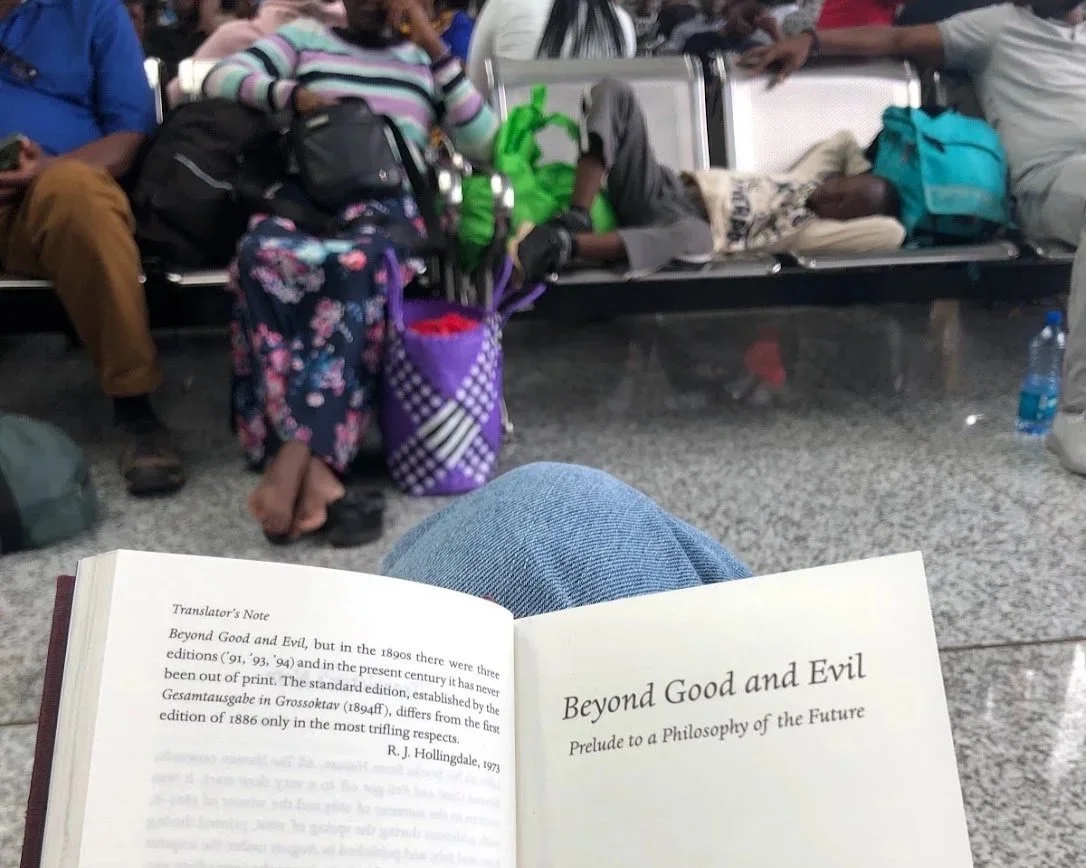
Reading Nietzsche’s “Beyond Good and Evil” while waiting for a train in Nairobi to take me to Mombasa. October, 2022.
“For every opposite, there is an equal. For every rivalry, a predecessor. For every predecessor, a broken telephone. For every perpetrator, a victim. For every victim, a perpetrator. For every country, a mirror. For every mirror, a hero. For every hero, a journey. For every journey, an arc. For every arc, an inevitable split into two. An outer and an inner. A heaven and a hell. A body and a mind. Asking us constantly. What do you see? What do you feel? How do you choose to make sense of this experience that you’re having? This experience that is, in and of itself, also having you.”
Roughly 3,740 km north-northeast of South Africa lies Kenya. Should you be lucky enough to travel this distance as the crow flies, what you’ll find are major cities uncannily similar to our own. Nairobi like Johannesburg—a hot, concrete urban spread with buildings reaching for the sky and graffiti works decorating walls where bulldozers have left jobs half-undone. Mombasa like Durban, with its tropical humidity producing sweat-drenched sailors who shout orders at each other in a trade language bridging taxi, truck and boat. Veering away from overcrowded Mombasa into a stretch of coastline that extends from Kilifi to Malindi, you find a landscape that appears just as the Garden Route in South Africa might have around 50–100 years ago. Exchanging Yellowwood for Baobab trees that have legal rights just as humans do and so can grow to over 1,000 years old. Unlike the Garden Route though, between them still live herds of elephant that come and say hello to the humans every now and again. I meet one from a distance. I watch as a village child reaches for the trunk of a bellowing beast, ears flailing back. Disturbed only by the fence that separates them, the child continues to reach for the grumpy giant without fear.
I was invited here in 2022 to attend a Cryptocurrency Conference. In amongst hay bales used as seats, we listened to Web 3.0 pioneers pitch ideas to address real-world problems with solutions offered up by hazardously idealistic emerging tech-evangelists. Non-alcoholic cocktails, given strange, untranslatable names, were offered to delegates to quench their midday thirst. After which no one was quite sure how both vision and speech had become so slurry. We laughed and giggled our way through the rest of the day. The fading day suddenly displayed a quality of light that made the light itself seem alive, sentient. Of its own self. Bearing in mind that the traveller’s mindset lends itself toward a deeper state of attention and noticing than feels possible in ordinary life. Whether as a result of or because of… I found my attention magnetized toward the people of Kenya in a way that I’m not as easily able to feel in my normal day-to-day. The women, in particular, appeared to me to carry themselves so regally, so self-possessed, centered, present. Belonging to themselves first. And, only if you were either lucky or in some way deserving, to you and the moment you shared together, fleetingly. Spines strong, standing upright. Like the light, they were of themselves. “What gives them this quality of energy?” I wondered. And, “Why do I not find this feeling at home in South Africa?”
It is difficult to find the words to describe to you exactly what I mean by this difference in energy. So let me give you a story, which will show you instead: “A man comes up onto the stage. Behind him is a large screen showing moving images that document a rural, barren landscape dotted with huts. Village women gather together in the video, tending to children and grinding maize into fine grain. The images give way to a walk-through of a new app that the presenter has developed to teach rural women financial literacy. He concludes the demonstration by saying something along the lines of, ‘Our project empowers women who would otherwise not be able to access their money because the men in their village oppress them.’” I feel the rumble of energy building around me before I hear or see it. I am sitting in amongst a group of Kenyan women, and they are clicking their tongues and waving their arms in the air dismissively. Eventually, one stands up, beating her fist against her chest as she does. She responds: “You cannot empower women. Our power does not come from you. Therefore, it cannot be taken from or given by you.” In the silence that followed, nothing but the sound of her fist beating against her chest could be heard. “Our power comes from here.” Her fist relaxed into an open palm. She let it rest against her heart.
As I write this experience down today, it is as fresh in my memory as the very day I experienced it. It would go on to forever change how I thought of and experienced myself as a cisgender white South African woman. I began to notice patterns of thought, speech and relating that had, up until that experience, not been visible to me. The way I preceded every idea or invitation with a diminutive to make myself appear smaller or less important… “Hey everybody, I have this lil story and maybe you might like to read it? If you’re not too busy, of course…” An apology ahead of every conviction… “I’m so sorry, but I just really think…” Self-deprecating humour to diminish possibility… “Hahaha ja, you know I’m just really not that good…” Struggle credentials to avoid attracting resentment… “Oh well, you know we were really poor when I was a child, so…” False gratitude to avoid socio-moral complexity… “I’m just so grateful to have a roof over my head…” Indirect speech to defuse honest perspective… “I was hoping that if you felt like it, you might…” Toxic positivity to dissociate from unresolved grief… “Well, we should just look on the bright side…” Martyrdom as a mode of relational control to prevent abandonment… “Oh yes, I can help. Anytime. Oh no. Not a hassle at all. Oh yes no sure, I’ve got so much extra time, not busy at all…”
Once you start seeing it in yourself, you start seeing it everywhere. Social conditioning. We are socialized to perceive ourselves in a certain way, and this becomes our default behaviour. Until you find yourself outside of your normal environment, exposed to a contrasting reality powerful enough to initiate an alternate state of consciousness. Then comes the realisation, “Oh heck, this isn’t normal.” Or, “This doesn’t have to be this way.” Or, “Holy heck, this is actually how I feel about this…” Then the work begins. The real work. The work you do with yourself. To unlearn and learn a new pattern of relating to yourself and to others. Then the work you do with others. Where you teach the world how to value and respect you by saying “yes” to what you want and “no” to what you don’t want. Boundaries, conditions and containment where required. And, generosity where it is available and abundant. No guilt. No resentment. No people pleasing. No self-abandonment. Just true, genuine generosity and presence. Where does your power come from? Place your hand on your chest. Feel that beating heart. There. Right there. That is the source of your power. You are of yourself. First and foremost. You belong to yourself.
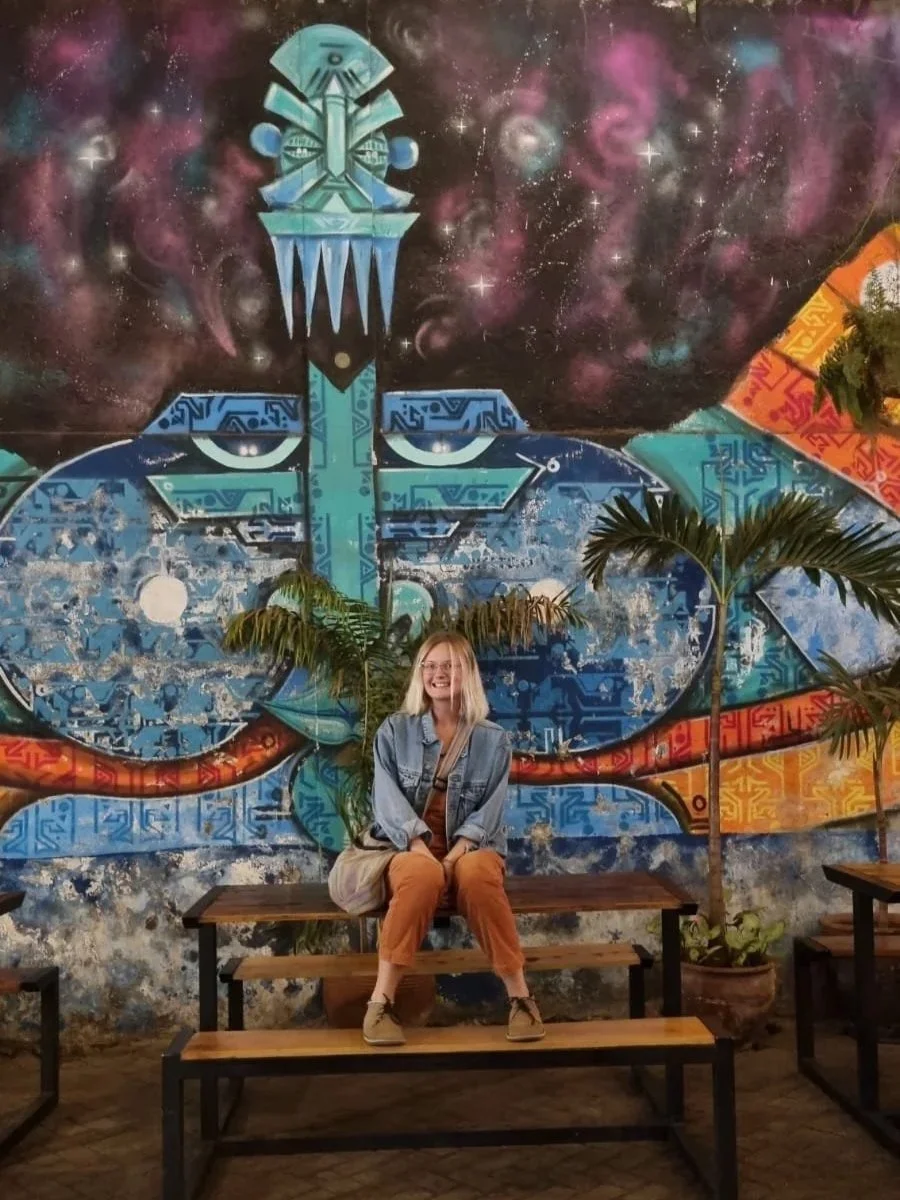
On assignment, covering a panel talk on Ecofeminism and Afrofuturism in Nairobi, Kenya. October 2022.
Creative writing is a powerful tool to support narrative change because the practice requires you to—quite literally—see your thoughts on the page. And then not only to witness your thoughts and words, but to make conscious decisions about how you would like to question, change or direct them. Within this practice, we work with story arcs: the movement of a story through conflict, change and resolution. Narrative structures provide frameworks for shaping that movement. They help us consider where a story begins, what disrupts it, what changes and where it leaves us.
Here is a video tutorial that can guide you through this process: Story Architecture.
One of the most widely used frameworks is the Hero’s Journey, associated with mythologist Joseph Campbell. Its broad movement is departure, initiation and return. A protagonist leaves a familiar world, encounters challenges and returns carrying something gained through the experience. Knowledge. Perspective. A new capacity to act. We often draw this journey as a circle. The protagonist moves away from what they know, faces resistance and encounters experiences that test their existing abilities and beliefs. At a crucial point, the old way of doing things is no longer enough. Something has to change.
It might be that they decide to “try again” one last time. It might be that they notice something they hadn’t seen before. It might be that help arrives, and they finally learn how to accept it. The precise turning point differs from story to story. It does not have to happen halfway through, and the journey after it is not necessarily a steady climb toward victory. But something has shifted. The protagonist can respond differently.
Cue: Rocky Balboa soundtrack.
The return brings this transformation into focus. Sometimes the protagonist comes back to the same physical place. Sometimes they return to a relationship, a responsibility or a question they could not face before. What matters is the relationship between who they were when they left and who they have become. Keeping the opening and closing setting the same can make this change particularly vivid. The place is familiar. The person encountering it is different. We see the transformation through contrast.
Paulo Coelho’s The Alchemist offers a useful example of departure, discovery and return. This kind of structure can serve stories of adventure, spiritual transformation and the search for meaning. Think also of Frodo in The Lord of the Rings. His journey takes him outward into danger, but its consequences are deeply internal. Returning home does not simply restore the person he was before.
This is where another framework becomes useful: the Heroine’s Journey.
Maureen Murdock developed her influential model in The Heroine’s Journey: Woman’s Quest for Wholeness in 1990, responding to what she found missing from Campbell’s account. Her emphasis is on the search for wholeness: questioning inherited measures of success, moving through disconnection and reclaiming parts of the self that have been rejected or neglected.
For our writing practice, we can use these journeys to explore a contrast in emphasis. What happens when we turn our attention from the outward quest toward the inward transformation?
Both journeys can contain action, conflict and psychological change. A plot arc follows the movement of events. A character arc follows changes in a character’s beliefs, behaviour or understanding of themselves. These can develop together. The useful question is where we place the reader’s attention—and what kind of change gives the story its meaning. How do we make an inward journey visible on the page?
Emotion and physical sensation give us one way in. The body becomes a landscape. Breath, tension, pain, warmth. The detail works best when it is specific enough to reveal this particular person in this particular moment. What is the sensation in the chest? How does breath move? Where does pain sit? How does that pain respond to a slight change in the environment? And how do small changes in behaviour reveal a shift in the protagonist’s understanding?
Perhaps a character always laughs before saying something serious. Later, they let the serious words stand on their own. Perhaps they begin the story rehearsing an apology and end it asking directly for what they need. We can also work through perspective: what the character notices, how they interpret it and what they are finally able to admit. The same silence might feel like rejection at the beginning of a story and room to breathe at the end.
A whole story can unfold this way. Perhaps the character spends the entire scene sitting in a chair, looking out of a window. Very little changes in the room. Yet something changes in their relationship to the world beyond it. The craft challenge is to make that movement perceptible. Give us a thought, a gesture, a decision or a detail that carries the change.
Here is a video tutorial that can guide you through this practice: The Heroine’s Journey: Writing Internal Transformation.
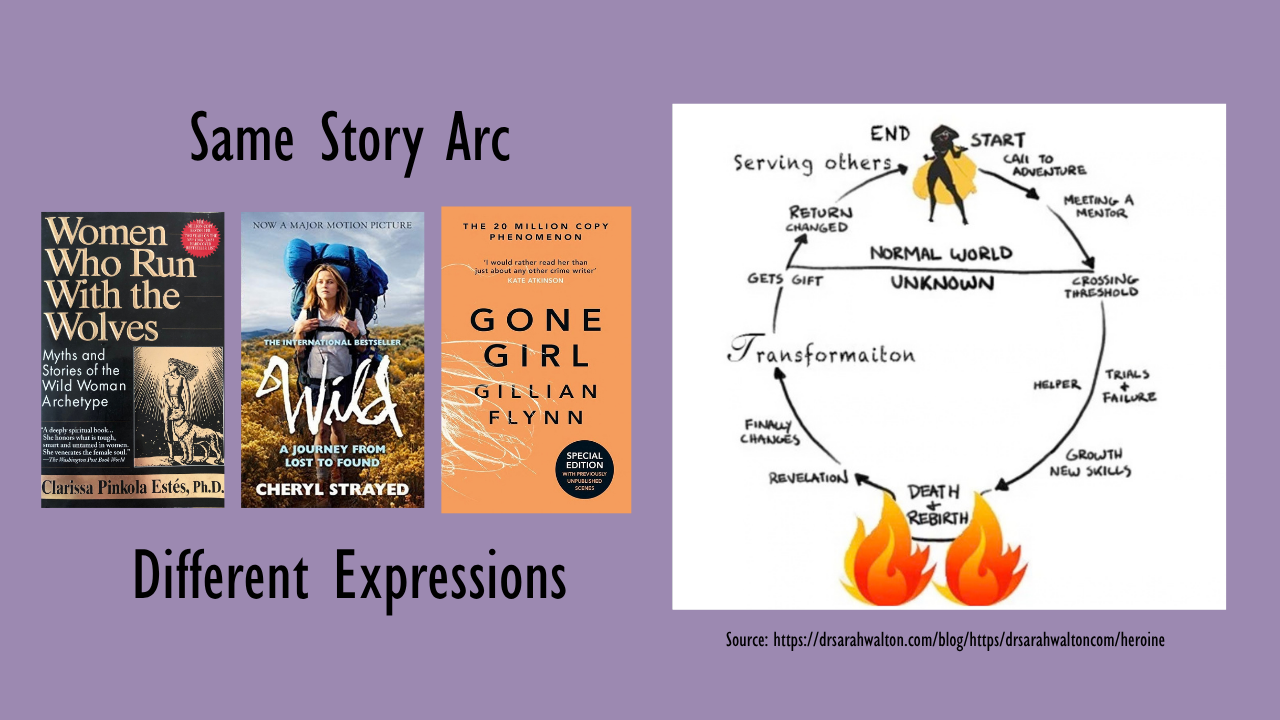
Lesson Slide: “The Heroine’s Journey asks what happens when a woman begins to question who she has been taught to be. What parts of herself has she silenced to gain approval, achieve success or belong? And what might it take to reclaim them?”
Clarissa Pinkola Estés’s Women Who Run with the Wolves explores women’s relationships with parts of themselves that have been neglected or suppressed. Her “Wild Woman” archetype invites women to reconnect with instinct, desire and ways of knowing that social conditioning may have taught them to distrust. Read alongside the Heroine’s Journey, this offers a way of understanding the inward quest: recovering a relationship with those parts of the self.
This also helps explain why it matters to give women’s internal worlds space to carry a story. Reese Witherspoon, of Legally Blonde fame, has championed that space through her production work. Her company Hello Sunshine explicitly centres women’s stories and authorship. For me, this connects to the possibilities opened by the Heroine’s Journey. Women whose experiences are the story. Whose grief, desire, anger and self-understanding matter in their own right.
We can read Cheryl Strayed’s Wild through this lens. Her roughly 1,100-mile hike along the Pacific Crest Trail gives physical shape to a reckoning with grief and the loss of her mother. Walking is the action. The inward journey unfolds through what she remembers, confronts and begins to understand about herself. This is a useful craft example: an external journey can make internal transformation visible. Each encounter, difficulty and decision can reveal a changing relationship to the self.
Gillian Flynn’s Gone Girl brings us to a more unsettling question: what happens when the pressure to perform an acceptable identity becomes destructive? Its troubled marriage and competing accounts of events give us a way to explore the distance between the self someone presents and what lies beneath. I read it here as a dark counterpoint to the search for wholeness. A character can expose the roles she has been expected to play without finding a healing way beyond them.
Reading these stories together helps us distinguish being good from becoming whole. The Heroine’s Journey makes room for an encounter with parts of the self that do not fit the approved image. Anger. Grief. Desire. Contradiction. What does the character do when she can no longer ignore them? Can she acknowledge them, take responsibility for them and find a different way to live?
For me, this is why complicated women matter in stories. No longer only good girls, pretty girls, lovable girls. Women can be grieving, contradictory, angry, destructive, searching. Understanding a character does not require us to approve of everything she does. But it can help us recognise what she has disowned—and what her journey toward wholeness might require. These stories expose us to shadows. They invite us toward a fuller experience of femininity, loosening the social pressure to be “good” so that we can begin asking what it means to belong to ourselves.
While these examples centre women’s experiences, the Heroine’s Journey—and its emphasis on femininity as an energy—is available to protagonists of any gender. We all carry feminine and masculine aspects within us, and the inward journey offers a way to bring these parts of ourselves into relationship as we move towards integration and wholeness.
So, when we use words such as hero and heroine, or masculine and feminine, it is important to be clear about how we are using them. Here, I am using masculine and feminine as symbolic language for contrasting orientations: outward movement and inward attention. This is a lens through which to explore a story. It is not a rule that men act and women feel, or that plot belongs to one gender and character to another. A protagonist of any gender can undertake either journey, or move between them. The contrast helps us ask: Where does this story locate its reward?
In an achievement? A victory? Recognition from the world? Or in a changed relationship to the self? The ability to grieve? A boundary finally spoken? Feeling different? Both can matter. Both can exist within the same story. But we don’t always need to go out into the world to create meaning and find fulfilment. And the biggest kinds of change don’t always require big announcements. We can show small, incremental shifts through language, attention and behaviour. Subtlety can draw our attention back toward what is within our range of influence. Our internal worlds. Our affect. Our sensitivity. Our ability to be present within our bodies.
This type of writing can offer a response to the helplessness we sometimes feel when the world becomes chaotic. Our influence over other people and outside events is limited. We cannot simply choose every thought or feeling that arrives. But we can practise noticing them, questioning the stories we attach to them and deciding how we want to respond.
Remember this? Place your hand on your chest. Feel that beating heart. There. Right there. That is the source of your power. You are of yourself. First and foremost. You belong to yourself.
That’s it. That’s the whole story.

Dante Rossetti’s eighth and final version of Proserpine (Persephone) now in the Birmingham Museum and Art Gallery (1882).
Our final 8-Week Creative Writing Discovery Course for 2026 begins on 14 October. Join a writing group travelling through the full lifecycle of a creative project together.
Or drop in to our Online Tuesday Sessions, where our community explores a new literary concept each week and puts it into practice through writing.
Email tanika@hatuakali-storytelling.org to book.
I’ll also be putting the Heroine’s Journey into practice in my upcoming solo music and storytelling show, Persephone’s Myth. Interweaving original songs and prose, it follows a daughter’s search for answers about her father’s death—and the inward transformation that unfolds along the way. Performance dates and booking details coming soon.
Visit www.thetanikajournal.com for sneak previews.
